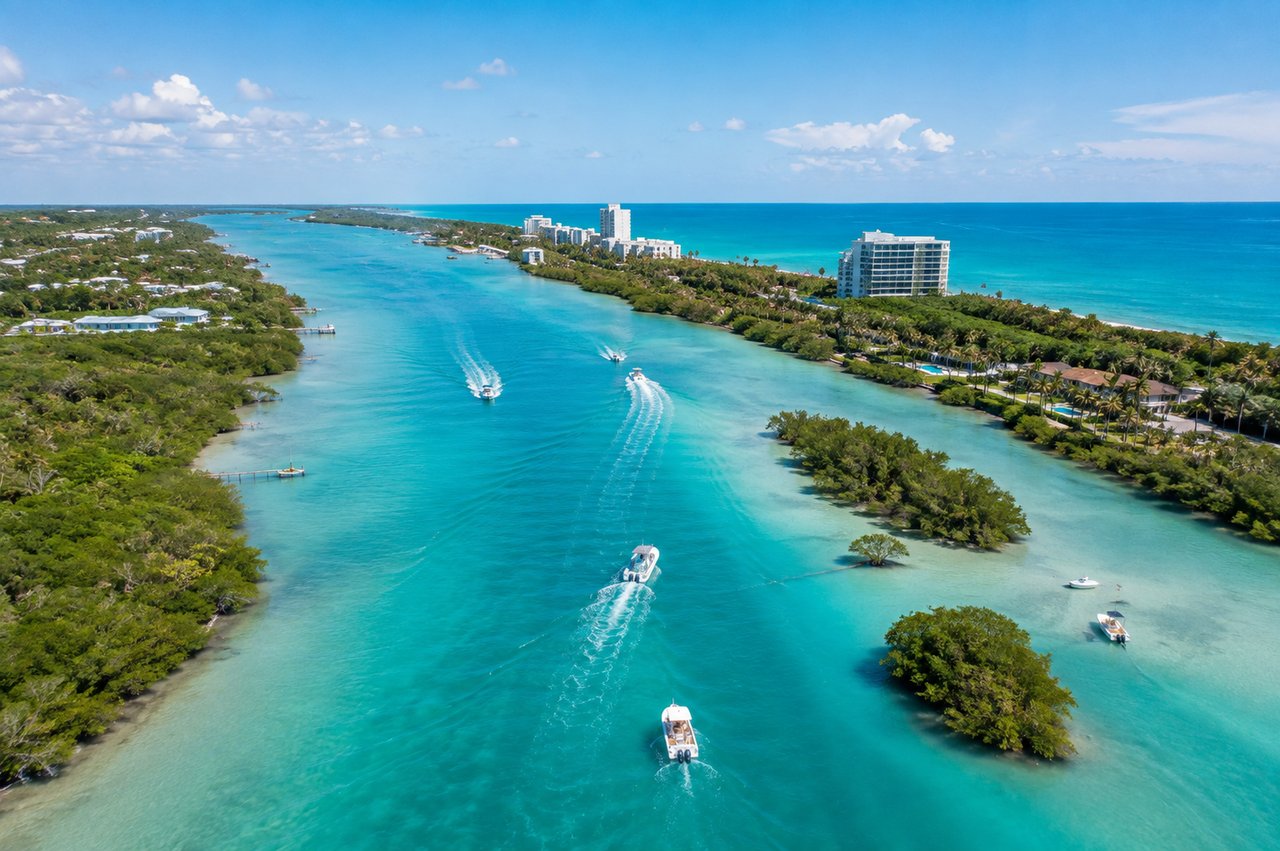
"The southernmost island right now is dead. It's a pile of sticks." Sue Panella of the Jupiter Narrows Conservation Alliance said this at the August 19 groundbreaking for the restoration of three mangrove islands in the Intracoastal off Tequesta. She was pointing at open water where mangroves used to grow. "If you look between our southernmost island and this island right behind us here, that used to be all mangroves. There's nothing there right now."
The $1.2 million project covers the stretch of the Jupiter Narrows that runs from Cato's Bridge, off U.S. 1 north of the Loxahatchee River, up to Coral Cove Park. Most of what gets built this fall is rock. It goes in around the islands, not on them. That choice says a lot about why the islands shrank and what has to change for them to come back.
The Rock Is A Wake Buffer
The restoration plan calls for natural limestone breakwaters, a hand-placed toe wall, and new mangroves planted alongside them. The goal is to cut the wave and boat-wake energy that has been eating away at the islands' edges. The Fish & Wildlife Foundation of Florida describes the same approach. The rock steadies the sediment and cuts wave damage so mangroves and seagrass beds can recover.
The Jupiter Narrows Conservation Alliance, or JNCA, is leading the work with Ocean Conservancy and the Andrew "Red" Harris Foundation. Taylor Engineering designed the plan. According to WPBF's coverage of the groundbreaking, the design also includes thousands of new mangroves.
A breakwater can't plant a mangrove or bring back seagrass. It changes the water around the islands so that plants have a chance to take hold. The engineering only works if the energy it absorbs stays at a level the rock can handle.
Where That Energy Comes From
JNCA lists the pressures on the Narrows habitat. Every item comes from people using the water:
- Boat wakes hitting the island edges
- Anchoring in seagrass and propeller scarring
- Tying watercraft to the mangroves or climbing on them
- Trash
- More boat traffic over time, plus historic waterways that were rerouted
How much has been lost is still an open question. At the Village's Environmental Advisory Committee meeting in September, a participant estimated that about five acres have disappeared over time. That figure is one resident's estimate, not a project survey. It fits Panella's description of open water where the islands used to connect.
What the islands still support explains why the project got funded. JNCA says the Narrows habitat holds birds, manatees, turtles, fish, rays, and sharks. It also calls the mangroves and seagrass important to local fisheries. Anglers working the Narrows depend on those same plants.
From Pledge To Permit To Rock
The project took years to reach the water. In December 2024, CBS12 reported that the Andrew "Red" Harris Foundation had pledged at least $175,000. At that point, installing the breakwaters was estimated at $750,000. The current figure is $1.2 million, which replaces that early estimate.
Date | Milestone |
|---|---|
December 2024 | Harris Foundation pledge of at least $175,000 reported |
March 31, 2026 | Florida DEP permit issued, per JNCA |
May 13, 2026 | U.S. Army Corps of Engineers permit issued, per JNCA |
August 19, 2026 | Groundbreaking ceremony |
September 9, 2026 | Village staff brief the Environmental Advisory Committee on the schedule |
September 16, 2026 | Crews scheduled to mobilize |
September 21, 2026 | Turbidity curtain scheduled to go in |
September 22, 2026 | Rock placement scheduled to begin |
Mid-October to November 2026 | Projected completion |
The last four rows are a forecast. Village staff gave those dates at the September 9 committee meeting and said the project would "proceed on a fast schedule." As of early October, no published update confirms how far the crews have gotten, names the contractor, or changes the finish date. At the August groundbreaking, WPTV reported that construction was expected to take several months.
The Village of Tequesta also has money in the project. JNCA says the Village has served as its municipal partner since 2024 and has submitted grant applications on its behalf. On top of that, staff said the Village contributed $5,000 directly.
The Name On The Islands
JNCA has named the islands in honor of a local man. A family member said the foundation wanted "to find a way to keep his spirit alive while giving something meaningful back to the community and the waters he loved so much."
WPTV reported that the man thought of these islands as his backyard.
"He loved fishing, diving, and being on the water. It was simply part of who he was." A family member
Running The Narrows While The Work Is Underway
No project notice has been published that shows where the work zone ends, where the turbidity curtain sits, or where a barge might be anchored. Until one appears, expect the curtain from the September schedule around the islands, and give any equipment in the water plenty of room.
The rule already in place is FWC's year-round slow-speed, minimum-wake zone. It runs about 2,225 feet north from Cato's Bridge. FWC announced the zone in February 2025 to address congestion and safety, not this construction. FWC says its markers sit about 100 feet outside both sides of the channel in front of Coral Cove Park, about 700 feet north of channel marker 59. The agency also notes that swimmers, paddlers, and kayakers use this part of the Narrows.
The two efforts work together. The slow zone cuts wake energy along part of the stretch, and the breakwaters take the rest at the island edges.
Coral Cove Park, at 1600 Beach Road, is the easiest public place to see the area from shore. Palm Beach County lists it as open sunrise to sunset, with 600 feet of Intracoastal frontage, saltwater fishing, parking, and picnic areas. A no-swim advisory issued at the park in late August was lifted on August 28. The Palm Beach Post noted that an advisory like that doesn't close the beach.
Three habits follow directly from the pressures JNCA lists:
- Keep anchors out of the seagrass flats near the islands.
- Don't tie a kayak, paddleboard, or boat to the mangroves, and stay off the roots.
- Slow down well before the marked zone if you're coming north from Cato's Bridge.
The Slow Part Comes After The Crews Leave
Once the rock is in, it stays. The plants will take much longer. "It's going to take years for the vegetation to come back the way it was a long time ago," said J.P. Brooker of Ocean Conservancy, "but we're creating the conditions for that nature to thrive."
A nearby project shows what can happen. In 2024, CBS12 reported an 860% increase in seagrass around a previously restored island in the Loxahatchee River. That was a different island, so it's no forecast for the Narrows. It does show that plants have come back in nearby water once wave energy was brought under control.
The finish date for the rock work is projected for mid-October to November. The mangroves planted inside it will take years to show the same kind of results.
If you spend your weekends on the water between Cato's Bridge and Coral Cove, you know how much the islands shape the Narrows. I follow projects like this one because they're part of how life on the water works here. If you'd like to talk about Tequesta's boating side, from Intracoastal access to the Loxahatchee and beyond, Kristin Wallace is always glad to compare notes. Let's Connect.
Related Reading
Living on the Loxahatchee River in Jupiter, FL
The Ultimate Guide to Boating in Jupiter, Florida
Top Questions Every Waterfront Buyer Should Ask Before Purchasing a Home in Jupiter, Florida
Deep Water vs. Fixed Bridge: What Jupiter Waterfront Buyers Need to Know
Ready to Buy or Sell a Waterfront Home in Jupiter or Tequesta?
Changes to local waterways, shorelines and waterfront infrastructure are important for homeowners and buyers to understand. When buying or selling waterfront property, details such as shoreline condition, docks, seawalls or rip rap, water depth, bridge access and boating routes can all play a role in how a property is evaluated.
Whether you are buying or selling a waterfront home in Jupiter, Tequesta, or the Northern Palm Beaches, I would be happy to help you understand your options and create a strategy that fits your goals.
Call or text Kristin Wallace at 781-771-5400 or email Kristin to get started.
